Thayer Site Facts
226 acres · Route 142 East · Oregon County, Missouri
Updated Sun, 20 Sept 2026

A landowner is offering land for sale. Nothing has been approved.

Charles W. McCullough owns 226 acres east of Thayer and has hired our firm to market the property. The property may have desirable features for many various users, and data center development is one of those potential users. As Mr. McCullough told the September 17 town hall: nothing is in contract, there are no offers, and there is no buyer. No offers are under consideration yet.

Buyer under contract
None
Offer received
None
Application filed
None
Construction started
None
Updated the same day anything changes. Last change: 20 Sept 2026.
01

This is the website we promised you

Since data center location is one of several possibilities for this property, this is the website we promised you. At the town hall on September 17 at Thayer High School we said information about this property was coming. This is it.

It is written and paid for by the firm hired to sell the land. We are not a neutral party and this page does not pretend to be one. What it does is put everything we know in one place, say plainly what we believe to be true, plainly state what is still unknown, and point you at the people who can check our answers.

If something here is wrong, contact us — the number and address are in section 09 — and we will correct it in public, with the date on it.

Commissioner Jake Parker said at that meeting that Oregon County currently has no ordinance governing a project like this, and that he is working on policies for the spring ballot. We think he is right to do it. We support written rules, and section 06 explains why.

02

Where it is

Residents posted a map of this parcel before we published anything. There is no reason for us to be less specific than they were.

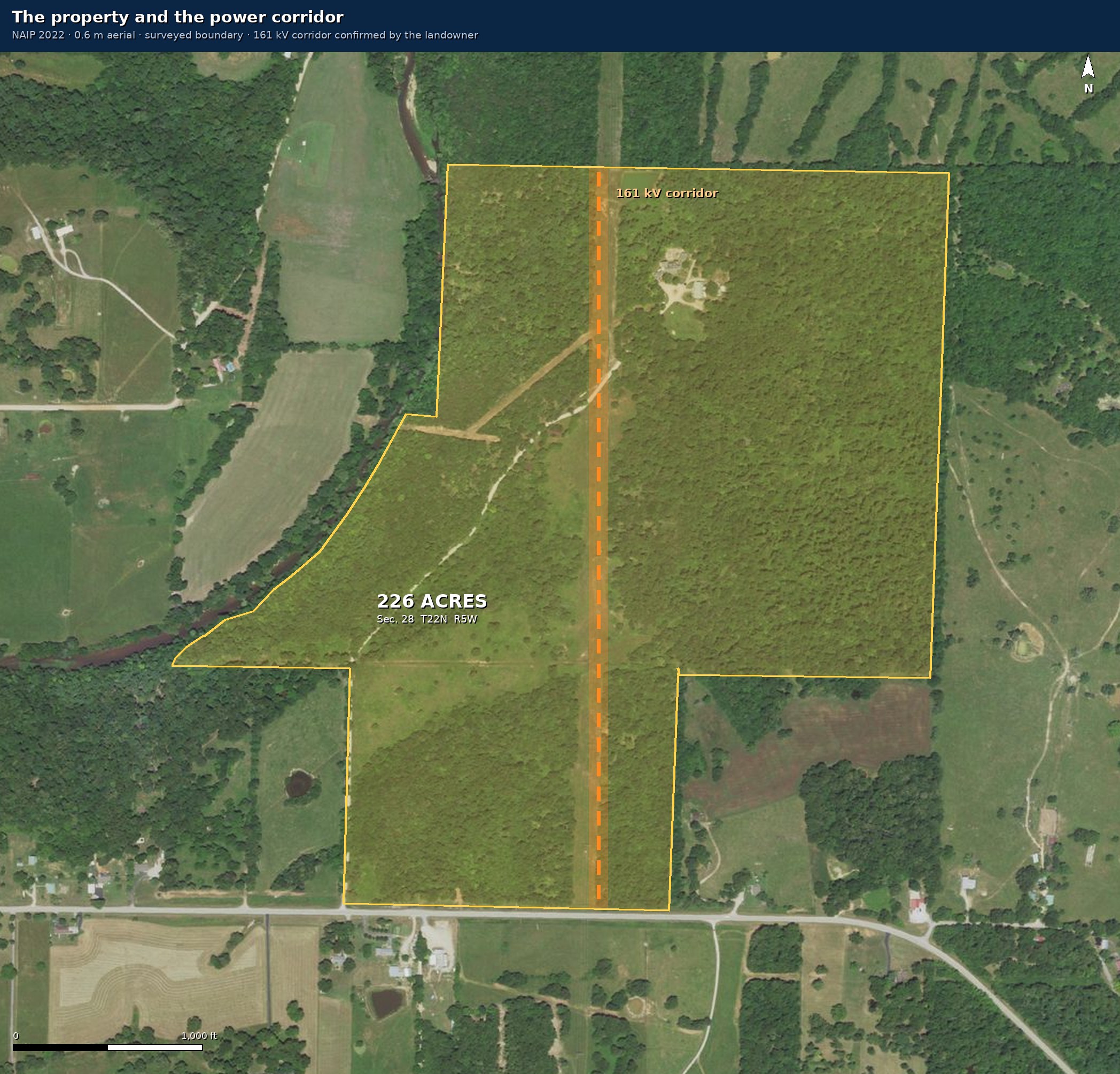
Aerial photograph of the 226-acre property east of Thayer, with the surveyed boundary outlined in yellow and the 161 kV power corridor marked in orange running north to south through the middle of the property.
Surveyed boundary of the property 161 kV power corridor Imagery: USDA NAIP 2022, 0.6 m

This is the actual surveyed boundary plotted on a real aerial photograph — not a sketch. The Warm Fork runs along the west and south edges and Route 142 borders the bottom. The orange line is the existing 161 kV power corridor, which already runs north to south through the middle of the property; its position here was identified from the cleared right-of-way visible in the photograph and confirmed by the landowner.

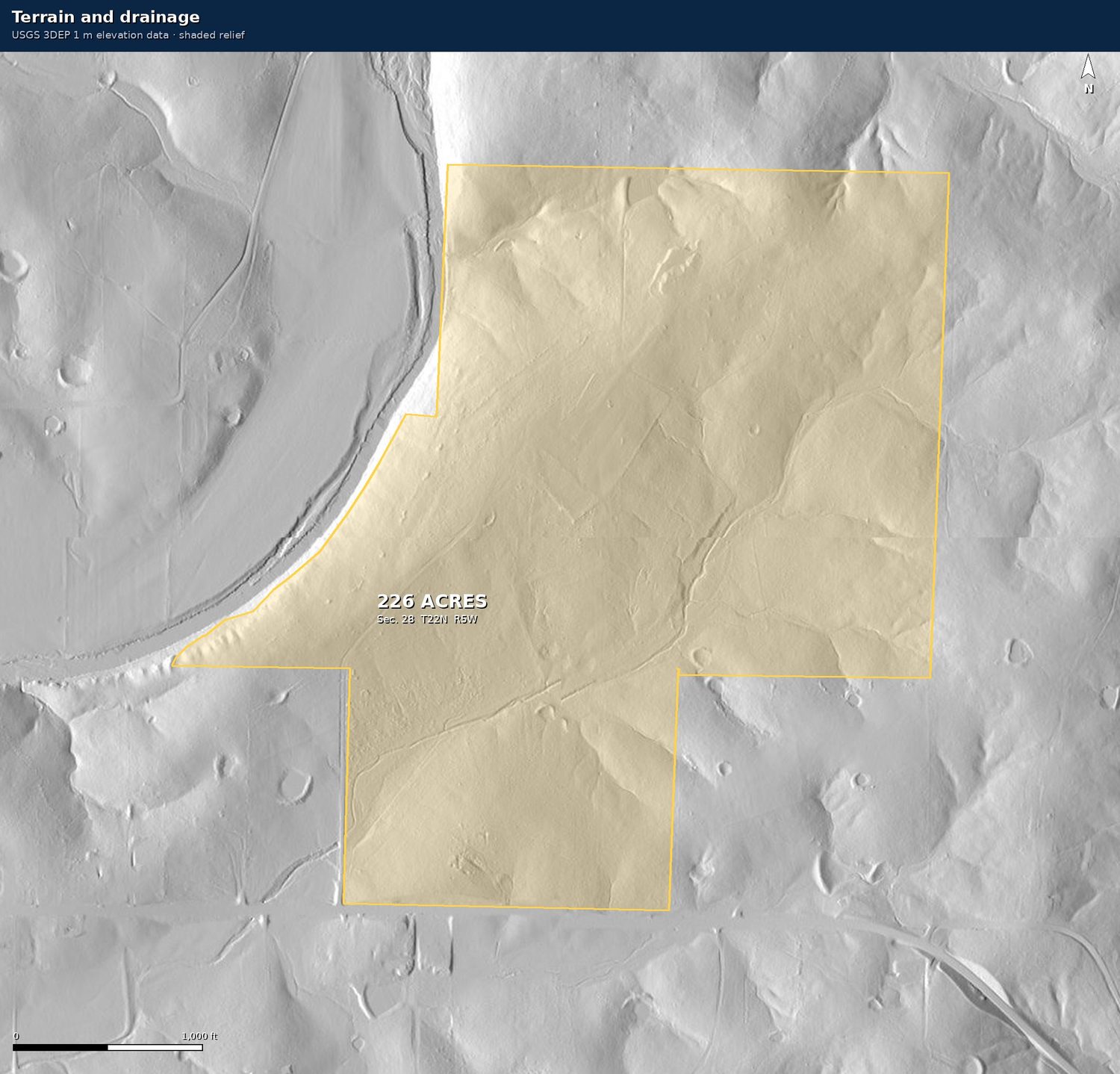
Shaded relief map of the property from USGS 3DEP one-metre elevation data.
Terrain and drainage. USGS 3DEP 1 m elevation data. Shows how water moves across the ground and where the draws run.
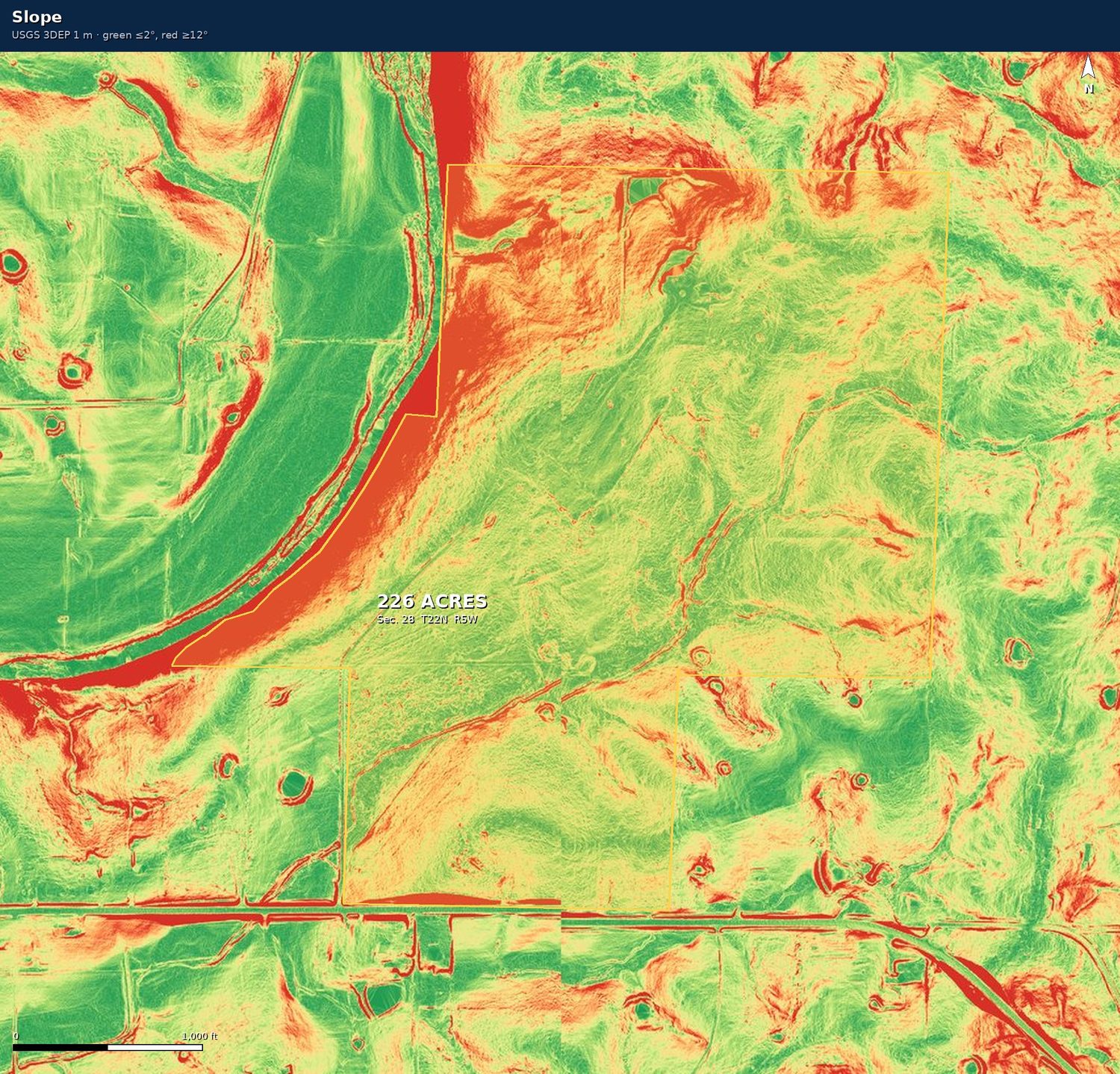
Slope map of the property, green for gentle slopes and red for steep.
Slope. Green is flat ground, red is steep. Only a limited part of the site is gentle enough to build on without major earthwork.
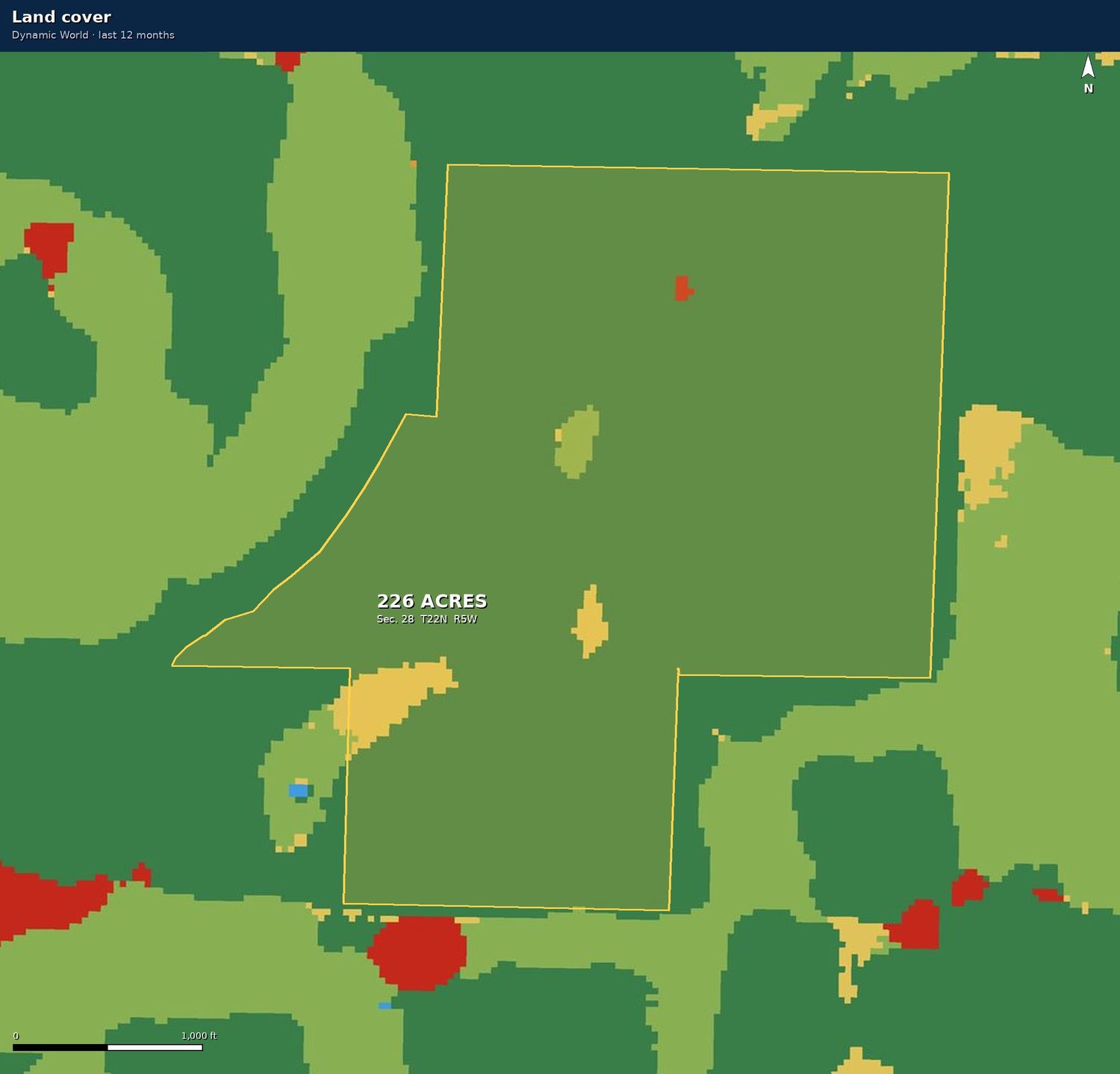
Land cover classification map of the property.
Land cover. What is actually growing there now — tree canopy, cleared ground and pasture.

How much of the 226 acres is actually in play

While a buyer may or may not want the entire 226 acres, from what we know, a small data center may need as few as six acres — roughly two and a half percent of the property. The rest is trees, draws, and river frontage.

That figure is from our own materials. It is not a permit, a plan or a promise.

Area
226.21 acres
Survey trace confirms the deeded figure
Location
Route 142 East
Outside Thayer city limits
161 kV corridor
Crosses the middle
Runs north–south, roughly 55% of the way across, for the full 3,950 ft depth
Transmission
161 kV and 69 kV
Both corridors cross the property
Substation
One exists already
South of the property
Electric territory
Howell-Oregon Electric
A member-owned cooperative
County zoning
No ordinance exists
Confirmed at the Sept 17 town hall
Warm Fork frontage
Along west & south edges
Visible on the aerial above; exact footage from survey
Former winery parcel
Already carved out
The 6.48-acre former McCullough winery tract is a separate parcel, excluded from the 226.21 acres
Groundwater
Ozark aquifer
The site sits above it
03

How big could it be

Large numbers have appeared in materials we circulated earlier, and people are repeating them. Below is what we believe to be more realistic, and where those bigger figures come from.

What is actually contemplated

Our assessment leads us to believe a likely scenario would be modest and staged:

2–4MW
A realistic first phase
~26MW
A possible later phase, if a buyer ever wanted it

For scale: a 2–4 MW building is a warehouse-sized facility, not the campuses people are reading about in Montgomery County or Virginia.

Where the 100 MW and 300 MW numbers came from

Earlier worksheets we sent to the electric cooperatives used 100 MW and 300 MW figures. Those were scenario ceilings — the answer to “what is the physical maximum this corridor could ever carry, if some developer asked for it” — not a plan, and not what is being pursued. Our own materials describe them as “planning-level, non-binding, and understood as subject to study.” We are publishing this explanation rather than letting those numbers travel without one.

Two corrections we want on the record. The “26 MW available” figure came from outside research, not from Sho-Me Power, AECI or Howell-Oregon — none of them has confirmed it. And nothing is being studied, applied for or filed with any utility: contact so far amounts to initial conversation between our firm and Sho-Me. If you hear that the utilities are “engaged” or that a study is underway, that is not accurate.

04

What we don't know yet

Most of what is circulating about this site consists of figures taken from data centers in other states. Here is every important question we cannot answer today. We would rather say so than fill the space.

Eight open questions

None of these has an answer yet, because there is no buyer and no design.

Buyer

No one is under contract and no offer has been received. We have had conversations. That is not the same thing and we won't describe it as more than it is.

End use

Unknown. It depends on a buyer who does not yet exist. That buyer may be an interested data center developer or any other interested client.

Water use

Unknown, and the honest range is enormous — near zero for air-cooled, millions of gallons a day for evaporative. Anyone quoting a number for this site is guessing.

Jobs

Unknown. Permanent staffing at facilities like this is usually dozens, not hundreds. Construction work is larger and temporary.

Tax revenue

Unknown. It depends on assessed value, which depends on what gets built. We believe even a likely small data center would be the largest single addition to the county's tax base in living memory, but we don't know what that number would be.

Noise

Unknown for this site. Cooling equipment does produce a continuous low hum. That is real and we won't argue otherwise. Detailed contract language can mitigate those problems before it arises.

Timeline

Unknown. There may never be one.

Whether anything happens

Unknown. Much land considered for this use never becomes a data center.

If you have read a specific number about this property anywhere other than section 03, it did not come from us.
05

Questions from the community

Taken word for word from what residents wrote online and asked out loud at the September 17 town hall. We have not softened them, and the timestamps refer to the meeting recording so you can check us. Every question we receive gets posted here with its answer — including the ones we would rather not have been asked. If we don't know the answer, we'll say so.

Question 01Kristen Good · 12 Sept
“Even with newer systems that offer closed loop, the water needs to be replaced from evaporation and that's where the impact is to our local water sources.”

You are right, and we want to say so plainly.

Some data systems, especially the earlier ones ten or fifteen years ago, used over a million gallons of water per day. Newer designs use dramatically less, and we are checking a report that at least one recently built system uses none at all. Unverified — we are checking this and will post what we find

“Closed loop” is a term that gets thrown around and it shouldn't be. A closed-loop system circulates its cooling water instead of consuming it, but it still loses water to evaporation and still needs replacement water. It is less. It is not zero. A number of facilities marketed as closed loop are in fact hybrid systems.

The useful response isn't to argue about the label — it's to demand a figure. Gallons per day, in writing, enforceable, on a meter someone local can read. A buyer unwilling to put that on paper has told you what you need to know.

Thayer Site FactsAnswered 20 Sept 2026
Question 02Bobby Bair · 12 Sept
“It would raise co-op rates and be a burden on the system… members could petition Howell-Oregon to not contract service with them.”

This is correct about how a cooperative works, and we're not going to pretend otherwise to protect our own position.

Howell-Oregon Electric is member-owned. Its members have standing with its board, and that board is a legitimate decision-making body. If members examine the terms and say no, that is a real answer arrived at properly.

On the substance: a large load should pay its own way — its own interconnection, its own substation, its own line upgrades — and should not be subsidized by people already on the system. It should not be a factor in future rate increases. If any arrangement shifts those costs onto ratepayers, residents should oppose it. So would we. See commitment 2.

Thayer Site FactsAnswered 20 Sept 2026
Question 03Skyla Caldwell · 12 Sept
“Their power grid can barely handle a thunderstorm let alone a data center.”

We're not going to argue with anyone about their own power outages.

Those outages happen on the distribution system — the poles and lines running to houses in and around Thayer. A facility of this kind would not connect to that system. It would take service off the transmission lines crossing the property, behind its own substation and its own equipment. You can see the 161 kV corridor on the map in section 02 — it has run through that ground for decades.

Whether the distribution system ends up stronger, weaker or unchanged is a question for Howell-Oregon and Sho-Me, and residents should put it to them directly rather than take our word for it. Their details are in section 07.

Thayer Site FactsAnswered 20 Sept 2026
Question 04Sheila Ronnie Campbell · 11 Sept
“We don't have the manpower (50–150) employees or the electrical stability for it.”

The skepticism about job numbers is warranted. Here is what we presently see.

Permanent staffing at a facility like this is modest — electricians, HVAC technicians, security, network staff — and it is measured in dozens. The larger employment figure is construction, and construction ends.

So the honest case is a small number of skilled permanent jobs, plus those required for the construction period. If anyone describes this as an economic transformation for Oregon County, treat that as a reason for suspicion.

Thayer Site FactsAnswered 20 Sept 2026
Question 05Dionne K Komm · 12 Sept
“I hate to see a long time resident consider doing this to our community.”

Mr. McCullough is a lifelong resident of the state line area. His late wife, Jo-Carroll, also taught school here. His children went to Thayer schools. He owned a wireless telecommunications company, built radio towers across southern Missouri and northern Arkansas, and designed several of the region's first E-911 systems.

He is 80 and is simply divesting himself of various assets. He has not, nor is he specifically looking for, a data center buyer.

While he has the right to accept or reject any offer on the property from any buyer, when the question of a data center arose, he learned there is some controversy surrounding those facilities. Therefore, he chose to go public at the outset and hear the voices and concerns of people in the area. He was under no requirement to do that.

Thayer Site FactsAnswered 20 Sept 2026
Question 06Angelika Sims · 12 Sept
“The noise level is a constant disturbance.”

True.

Cooling equipment runs continuously and produces a low-frequency hum that carries, particularly at night and particularly in a valley. It is less pronounced in recent systems, but anyone who has stood near one knows the sound.

The way it gets handled elsewhere is a hard limit on loudness measured at the property line, with the operator paying for monitoring. Setbacks and berms matter too. These are conditions that can be imposed, but only before a design is fixed, which is now. See section 06.

Thayer Site FactsAnswered 20 Sept 2026
Question 07Dionne K Komm · 12 Sept
“It would be interesting to know who is marketing the land for this.”

Nations Media Partners, of Kansas City. We have handled telecommunications and infrastructure transactions since 1996. We are hired by sellers — so we are paid to sell this land, and we'll say that out loud rather than present ourselves as neutral.

Which is exactly why nothing on this page should be taken on our word alone. Every claim here names a source you can check, and section 07 lists the agencies and boards that can answer questions when we don't know the answers.

Thayer Site FactsAnswered 20 Sept 2026
Question 08Skyla Caldwell · 11 Sept
“Can we petition against this? I don't think anyone wants this here.”

Yes, and residents have already started.

Section 07 sets out which bodies actually have authority here, when they meet and how to reach them — because a petition delivered to the wrong body accomplishes nothing.

Our hope is that people organize around the real verified problems rather than some of the versions circulating online. Commissioner Parker is drafting county policies for the spring ballot. That process is the one that will actually decide how this county handles projects like this, whether it is our client's property or someone else's, which will likely come along anyway in the near future.

Thayer Site FactsAnswered 20 Sept 2026
Question 09Town hall · 17 Sept · 1:40:14
“We have a petition that we don't want this. There's 1,115 that says no. So with you saying you would stop this, are you going to — with what we have, that everybody is saying no — or do we need more votes?”

The petition is real, the number is real, and we are not going to pretend it wasn't said.

Earlier that evening Mr. McCullough was asked directly whether enough community resistance would make him reconsider putting a data center on this land. His answer was one word: “True.” That is on the recording at 1:35:06 and we are repeating it here rather than leaving it for someone else to find.

What we will not do is put a number on it. He has not said “1,115 and I stop” and we are not going to invent a threshold he did not set. What we can tell you is that this is his decision, he made that statement in a room full of people, and he has to live here afterwards.

Thayer Site FactsAnswered 20 Sept 2026
Question 10Town hall · 17 Sept · 56:21
“Have you really looked into the chemicals that they actually use? … Many of which contain toxic per- and polyfluoroalkyl substances. PFAS is a forever chemical. Once it gets into the water, you ain't getting it out. … You are sitting directly on top of the Ozark Plateau aquifer system.”

This was the most serious question asked all night and it deserves better than a brush-off, so here is what we know and what we believe to be the approach to prevent that problem.

She is right that these buildings are not chemical-free. The categories are real: refrigerants in the cooling plant, glycol in closed-loop systems, corrosion inhibitors and biocides in any open cooling tower, dielectric fluid in immersion cooling, and whatever agent is used for fire suppression. Anyone who tells you a data center is just computers and air is skipping a step.

Where we would push back on the detail, while agreeing with the concern: not all of those are PFAS. Propylene glycol in a sealed loop is not a forever chemical. But some immersion cooling fluids have historically been fluorinated, and some firefighting foams contain PFAS — which is exactly why it matters what a specific buyer specifies, and why “trust us, it's modern” is not an answer.

So the proposal we suggest is a prohibition rather than a vague promise: no PFAS-containing coolant and no PFAS-containing fire-suppression agent on this site, written into the sale, plus a publicly posted inventory of every fluid held on the property in any quantity, updated annually. If a buyer will not accept that, they are the wrong buyer. Proposed — being documented

On the aquifer: she is correct about what sits underneath. That is also why the baseline hydrology study in our recommendations matters — a chemical question and a water question are the same question here.

Thayer Site FactsAnswered 20 Sept 2026
Question 11Town hall · 17 Sept · 1:09:46
“We moved here from a very large state and because it's dark here — he's a retired astronomer, that's why we moved here. … Lighting, yes, it affects the hunting, it affects so many other things, the birds, everything. … Be a good neighbor, please.”

This one is easy to fix and expensive to ignore, and it should be addressed.

A dark sky is an asset that this county has and most places have lost. Industrial sites wreck it through habit rather than necessity — unshielded fixtures throwing light sideways and upward, and everything burning dusk to dawn whether anyone is there or not.

What should be required are fully shielded, full-cutoff fixtures with no light emitted above horizontal; warm colour temperature; lighting aimed and metered so that illumination at the property line is effectively zero; and motion-triggered rather than all-night operation everywhere security does not strictly require otherwise. That is a normal dark sky standard. It is cheap and it can be required. Proposed — being documented

The same condition addresses the wildlife question asked a moment earlier — deer, birds and insects respond to light spill more than to the building itself.

Thayer Site FactsAnswered 20 Sept 2026
Question 12Town hall · 17 Sept · 1:20:52
“How do you guarantee? What do you give us? What do you give me? … How are you going to assure me that those things are going to happen? … I live here too.”

You are right that a promise on a website is worth nothing, and we would rather answer the mechanism than repeat the promise.

A commitment is only worth the document it sits in. Three things make one enforceable.

One — put it in the deed. Conditions written as restrictive covenants run with the land. They bind the buyer, and they bind whoever the buyer sells to in fifteen years. They do not depend on anybody remembering a meeting.

Two — give somebody standing to enforce it. A covenant enforceable only by the seller is close to worthless once the seller is out of the picture. That brings us to the county; the county, and adjoining landowners, should be named as parties able to enforce it.

Three — the county ordinance. Commissioner Parker's ordinance is the part that does not depend on this landowner or this firm at all, which is precisely why it makes sense. See section 06.

Commitments mentioned in section 06 can be recorded as covenants rather than stated as intentions. That is the answer to “how do you guarantee it.” Proposed — with counsel

Thayer Site FactsAnswered 20 Sept 2026
Question 13Daniel Crowder · town hall · 17 Sept · 1:07:26
“Most of the contractors are not going to be local. … They're going to bring in a big company from elsewhere … they're going to do the job, you're going to the next company.”

He is right, he operates heavy equipment for a living, and we are not going to argue with the man who does the work.

Large construction projects arrive with their own crews. The mechanical and electrical trades on a build like this are specialised and they travel. Anyone promising this county a construction boom is overselling it.

What is realistically local is the lower end of the supply chain — rock and aggregate, hauling, site clearing, fuel, equipment rental, and the food and lodging spend while crews are here. That is real money for a few businesses for a year or two. It is not a jobs programme.

We would support a local-first requirement on subcontracting and materials be written into a sale, but we are not going to claim it changes the basic picture Mr. Crowder described.

Thayer Site FactsAnswered 20 Sept 2026
Question 14Town hall · 17 Sept · 1:30:48
“Once it's outdated, we end up with a pile of junk in the middle of a field somewhere that nobody can use it for anything. The technology is moving this fast. Who's going to reinvest that?”

This is the risk nobody in the industry likes discussing and the questioner has it exactly right.

Hardware cycles are short. A building designed around today's equipment can be economically obsolete well before it is physically worn out, and the failure mode is not dramatic — it is a fenced, empty structure whose assessed value falls away, leaving the county with something it cannot tax at anything like what it cost to build.

The protection is a decommissioning bond: a surety posted before construction, sized to demolition and full site restoration, indexed to inflation, held by the county, and released only when the ground is back to grass. It costs a serious buyer very little and it costs an unserious one a great deal, which is the point.

We think this belongs in the county ordinance, whether or not anything ever happens to this property.

Thayer Site FactsAnswered 20 Sept 2026
Question 15Town hall · 17 Sept · 1:19:15
“Your strategy coming at us first saying you're all transparent is nonsense and you're trying to wear us down. … You made all these statements about how you're going to only let in a good data center, but we all know that all goes out the door for dollars.”

We are publishing this one because leaving it out would prove the point.

The incentive is exactly what he says it is. Our firm is paid on a completed sale. Mr. McCullough would be paid for his land. Neither of us is disinterested and we have said so on every page of this site.

So do not weigh our motives — weigh things you can check. We are not seeking a tax abatement, and you can confirm that with the county at any time. We asked the commission to write an ordinance that would constrain us. Mr. McCullough said on the record that enough community resistance would make him reconsider. Every question we have received is posted here, including this one, unedited.

Any of those can be tested, and if we break one of them you will have it in writing. That is the only kind of trust worth offering and it is the only kind we are asking for.

Thayer Site FactsAnswered 20 Sept 2026
06

Why we want the county to write rules

An ordinance protects residents. It also protects the deal.

At the town hall, Commissioner Parker said Oregon County has no ordinance that would let it set conditions on a project like this, and that he is drafting policies for the spring ballot. We support that, and we want to be straightforward about why it is in our interest as well as yours.

A serious buyer will not spend a hundred million dollars in a county where the rules could be invented after they break ground. Uncertainty is the single most expensive thing on a site like this. Written standards — the ones residents have been asking for anyway — turn an argument into a checklist. That is worth more to a buyer than any tax break.

So we are not asking the county to hold off. We are asking it to be specific, and we will help draft anything it asks us to help draft, including standards that are harder on a buyer than the county might otherwise write.

  • Water disclosure
    Published gallons-per-day limits with independent metering
  • Baseline studies
    Hydrology and well monitoring before construction, published
  • Noise limits
    Enforceable limits at the property line, operator-funded monitoring
  • Cost allocation
    The load pays for its own grid upgrades, never ratepayers
  • Setbacks
    From the Warm Fork, from homes, from the highway
  • Decommissioning
    A bond so the county is never left with an empty building

What we seek from any buyer

  1. 1

    No tax abatement or incentive will be sought. No abatement, TIF, Chapter 100 financing or incentive package from Oregon County or the City of Thayer. Any facility goes onto the tax rolls at full assessed value.

  2. 2

    The buyer pays for its own power. Full cost of interconnection, substation and any transmission or distribution upgrades falls on the buyer. No cost shifted onto cooperative members or ratepayers.

  3. 3

    A baseline hydrology study before any construction — completed and published publicly, so that there is a clear, dated record of what the water was like before anything was built.

  4. 4

    An enforceable noise limit at the property line, including appropriate numbers, with monitoring paid for by the operator.

  5. 5

    No process discharge to the Warm Fork.

  6. 6

    The buyer and the intended use disclosed publicly when a contract is signed — before closing, not after.

  7. 7

    We will attend any public meeting we are invited to and answer questions for as long as people want to ask them.

Items 1, 2, 5 and 7 are our standing position today. Items 3, 4 and 6 are positions we are working through with counsel now, and the exact wording will be posted here when it is settled rather than described in summary. Anything on this page marked Proposed is a position we intend to take and have not yet finished documenting — we would rather show you the work in progress than wait and present it finished.

07

Who actually decides

There is no rezoning hearing, because there is no zoning ordinance. That does not mean there are no decision points. Each body below has real authority over some part of this, and none of them is us.

How power would actually get here

This matters because it determines who decides, and who pays. The co-op at the left is member-owned — and its members have standing with its board.

AECI Generates the power Sho-Me Power 161 kV / 69 kV transmission Howell-Oregon Distributes to homes Your house and Thayer A large load would connect here instead
Member-owned · Distribution

Howell-Oregon Electric

A member-owned cooperative serving this area. Members have standing with the board. If the co-op declines to serve a load, that decision stands on its own.

Aaron Wheeler, CEO
Member services via HOEC
Transmission · G&T cooperative

Sho-Me Power

Owns the 161 kV and 69 kV lines crossing the property, and the substation south of it. Any transmission service and any cost allocation runs through Sho-Me and its wholesale supplier, AECI.

301 W. Jackson St.
Marshfield, Missouri
County · Meets weekly

Oregon County Commission

Presiding Commissioner David Stubblefield; Associate Commissioners Dennis Morgan (1st) and Jake Parker (2nd). Thursdays, 8:00 a.m. Commissioner Parker is drafting county policies for the spring ballot.

County Clerk
417-778-7475
City · Property is outside limits

City of Thayer

Mayor Donna Martin; City Administrator Brent Collins. The property lies outside the city limits, but city utilities, roads and the Five-Year Plan are the Board of Aldermen's.

124 North Second Street
417-264-3921
State permits · Comment windows

Missouri DNR

High-volume water withdrawal, wastewater, stormwater and air permits for backup generators each carry a public comment window. These are the formal points where objections enter a legal record.

dnr.mo.gov
Ballot · Spring 2027

The spring ballot

The county policies being drafted now are the decision that will actually govern how Oregon County handles projects like this — ours or anyone's. It is the process most worth your attention.

Watch the Commission agenda
417-778-7475
08

Record of updates

Entries are added, never edited. A correction appears as a new entry rather than a quiet rewrite.

09

Ask us something

Every question gets posted

Questions we receive are published in section 05 with their answers — including hostile ones, and including the ones where the answer is that we don't know. We don't collect addresses and won't add anyone to a mailing list.

Contact

Nations Media Partners
(816) 643-6888
matt@nationsmedia.co
2400 E. Truman Rd., Suite 200
Kansas City, MO 64127